 Home Renovation
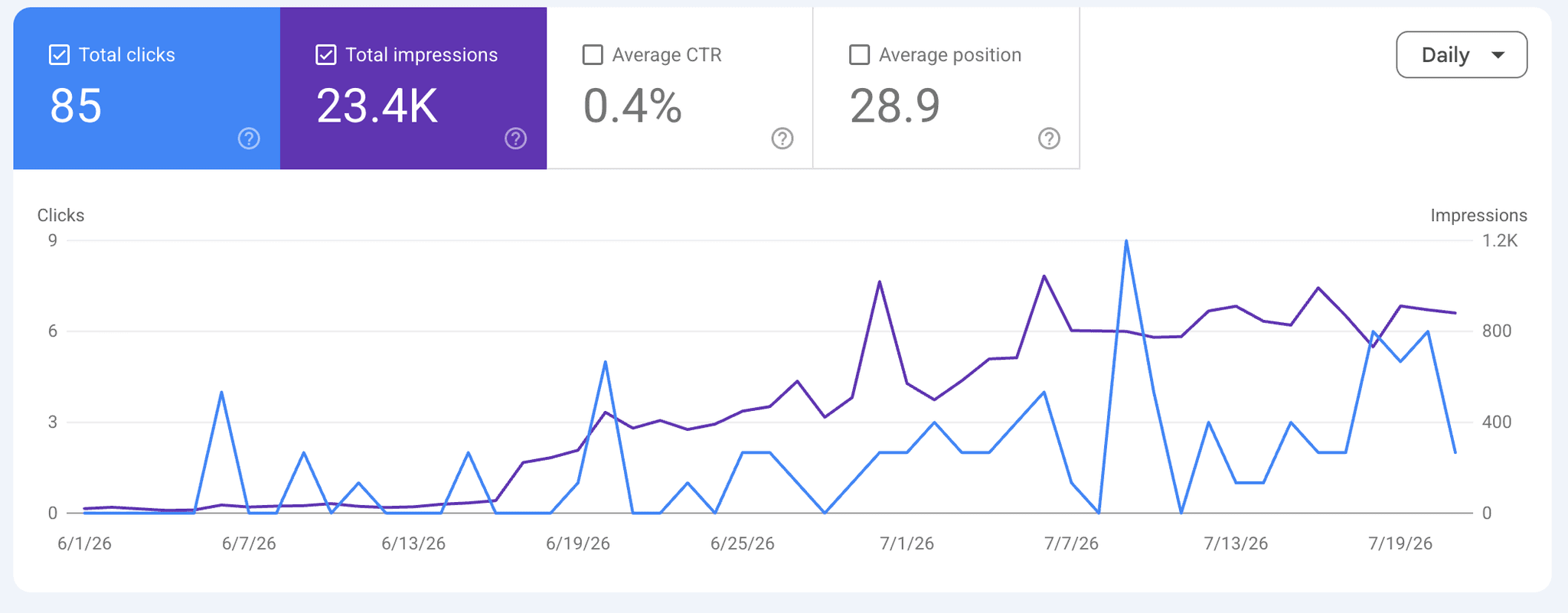
+56.1%
more clicks from Google, quarter over quarter
Osoba Renos Home Renovation case study
From invisible to indexed and ranking across the GTA
When a customer asks ChatGPT, Gemini or Google for a recommendation, we make sure yours is the name that comes back. That is Generative Engine Optimization — GEO, SEO’s successor. We do both.
Clients with published results

Photo: a finished Osoba Renos project. Figures: Google Search Console.
Every figure links to a full write-up: what was wrong, what we changed, what happened next.
 Home Renovation
+56.1%
more clicks from Google, quarter over quarter
From invisible to indexed and ranking across the GTA
 Interior Design
2→1
fragmented profiles, one entity
From a fragmented identity to one entity engines can resolve
 Consumer App
0→1
category made discoverable
A brand-new category, made findable in the answer
 Home Services
+331%
more clicks from Google, in seven weeks
Search visibility climbing fast across the GTA
People no longer only search. They ask. Each engine decides what it recommends differently, so each one has to be earned differently.
2004
Search meant a ranked list. You optimised for position, and a click was the only currency.
2015
Engines started understanding meaning, not strings. Knowledge panels and rich results reshaped the page.
2023
Generative models began answering directly. The destination became the response, not the website.
Now
People ask assistants and act on what they're told. Visibility is being named, or being invisible.
Generative Engine Optimization is what the fourth move made necessary. How GEO differs from SEO and AEO.
Software tells you what changed. Neither does the next piece of work. That gap is the job.
Every week the same loop runs: watch the surfaces, work out what changed and why, rank what it is worth fixing, ship it.
Signals
Diagnosis
Actions
Results
What a finding looks like: illustrative, not a client’s results
Competitor A is appearing in 14 high-intent AI questions where your brand is absent.
Likely cause: Third-party authority gapNext action: Strengthen authoritative references and supporting content.
High impact
Your Toronto service page ranks but is rarely cited by AI systems.
Likely cause: Thin entity + answer structureNext action: Improve entity clarity, supporting evidence, and answer structure.
High impact
| Dimension | Traditional agency | Marketing software | LumiRank |
|---|---|---|---|
| Strategy | Multiple specialists, disconnected channels | Dashboards and recommendations | One connected strategy across search, AI, and the funnel |
| Execution | Slow, manual reporting | You still need a team to act on it | SEO, GEO, content & technical work shipped directly by us |
| Intelligence | Point-in-time audits | Automated data, no interpretation | Continuous, AI-prioritized opportunity detection |
| Accountability | Recommendations and execution are separate parties | No one is accountable for the outcome | One team, one system, one accountable partner |

Founder & Generative Engine Optimization strategist
Dmytro founded LumiRank to answer one question: when someone asks an AI which brand to trust, whose name comes back? He works at the seam of classical SEO and Generative Engine Optimization, building the entity architecture and semantic authority that make brands the source models cite.

Technical · 10 min read

Strategy · 10 min read

Research · 10 min read

GEO · 10 min read

Strategy · 9 min read

Technical · 13 min read
The short version of how Generative Engine Optimization works, and where it differs from the SEO you already know.
Still deciding? Talk to a Growth Strategist.
Generative Engine Optimization (GEO) is the practice of making a brand the source that AI answer engines (ChatGPT, Claude, Gemini, Perplexity, Google AI Overviews and Copilot) cite, paraphrase, and recommend. Instead of optimizing for a ranked list of links, GEO engineers the structured facts, corroborated claims, and off-site mentions that decide whether a model names your brand in its answer.
Traditional SEO optimizes for position in a list of ten blue links and is measured in clicks. GEO optimizes for being named inside a single synthesized answer and is measured in citations, mentions, and share of model voice. SEO remains the entry ticket, since most AI surfaces still draw from pages that rank, but GEO adds entity architecture, semantic authority, and off-site corroboration that classical ranking factors don't capture.
We optimize for the major answer engines and the indexes behind them: ChatGPT (Bing index plus OpenAI's own crawler), Google AI Overviews and AI Mode (Gemini grounded in Google Search), Perplexity, Claude, Gemini across Google's products, and Microsoft Copilot (grounded in Bing). Because each engine sources answers differently, we tune the entity, content, and citation signals each one rewards.
We track a maintained panel of the prompts your buyers actually use, run them across every major engine on a schedule, and measure share of voice (how often you're named versus competitors) alongside the sentiment and accuracy of how you're described. The output is a weekly baseline and trend, tied to the specific actions moving your numbers, rather than click counts that AI answers no longer generate.
Yes. Crawlable, fast, cleanly rendered pages are a prerequisite, because engines can't cite what they can't reach or parse, and Google's AI surfaces draw heavily from pages already ranking in classic Search. GEO builds on that foundation with structured entities, topical depth, and earned off-site mentions, which recent studies find correlate with AI visibility far more strongly than backlinks alone.
Technical and entity foundations can be corrected in weeks, but visibility compounds: most engagements see measurable movement in share of model voice within one to two quarters as corroborating mentions accumulate and engines update what they know about your brand. GEO is a continuous operating rhythm, not a one-time launch. Gains build on each other and become harder for competitors to dislodge over time.
Service and guide pages by city and by topic.
Twenty minutes, no slides. We look at where you surface across Google and the AI engines, what your paid, social and conversion picture looks like, and where a competitor is being named instead of you.
You’ll talk to Dmytro Hrysiuk, not a sales rep.No pitch and no retainer talk on the call. If a paid audit is the right next step we will say so; it is a separate, unbundled product. Want the detail first? See how LumiRank works.