YaDesign Inc.
How an interior design studio working across Toronto and Los Angeles earned one coherent identity that search engines and AI assistants can resolve.
Approach
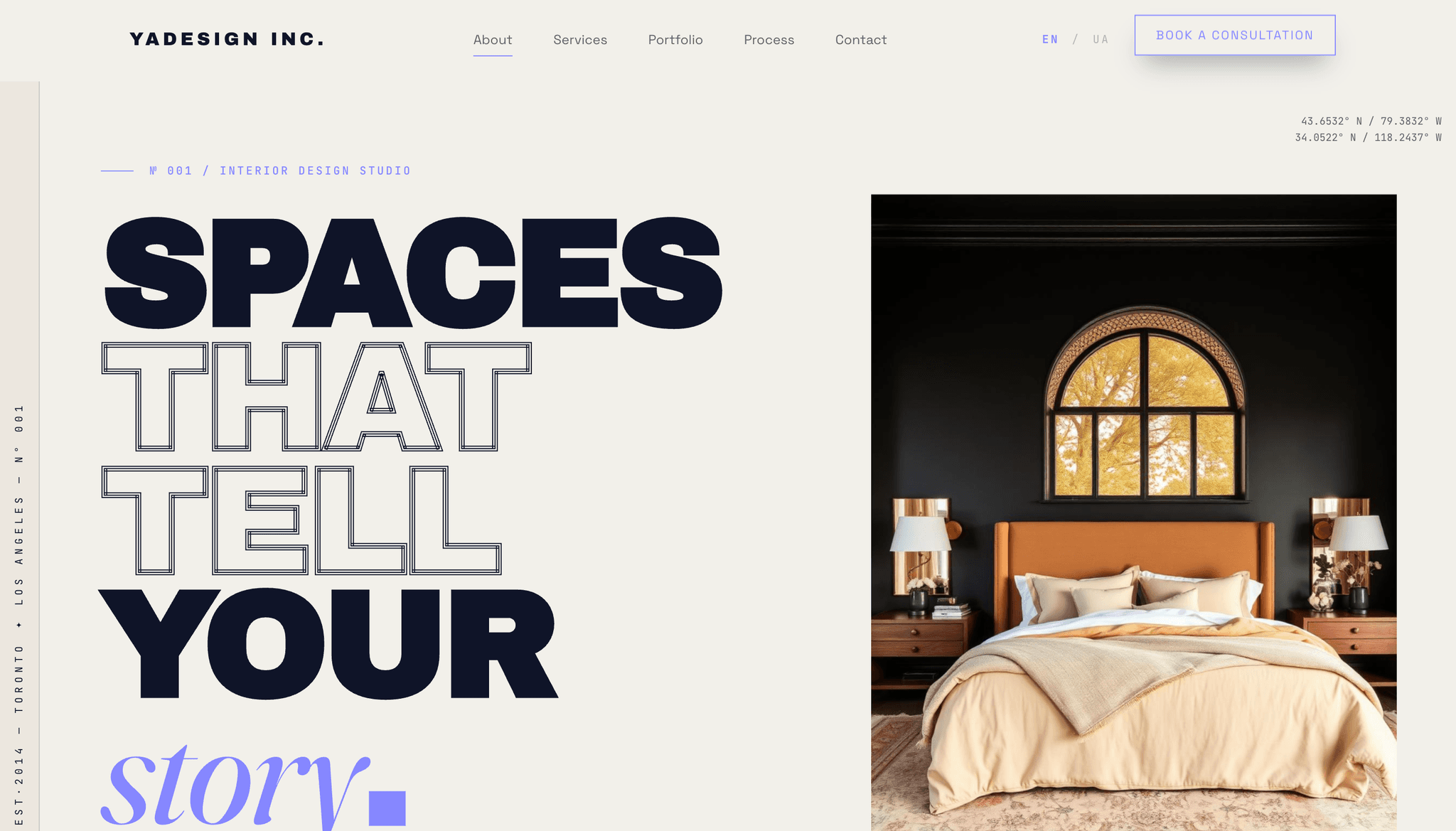
YaDesign Inc. has designed residential, commercial and hospitality interiors since 2014, spaces meant to tell the owner's story. The work is bicoastal in the truest sense: an active practice in Toronto and a second in Los Angeles, roughly 3,500 kilometres and a very different design culture apart.
That reach was the problem online. Two cities, a bilingual (English and Ukrainian) audience, and a portfolio scattered across profiles gave engines conflicting signals about who YaDesign is and where it works. A person reading the site understood instantly; a model trying to resolve the entity had to guess. And guessing means getting left out of the answer.
We gave the studio a single, unambiguous identity and let each market stand on its own: one canonical entity, distinct local presence in Toronto and Los Angeles, and topical depth built around the disciplines YaDesign actually leads with, so search and AI both know exactly who to name, in which city.
At a glance
The client
YaDesign Inc., an interior design studio founded in 2014, working across residential, commercial and hospitality projects in both Toronto and Los Angeles, serving an English- and Ukrainian-speaking clientele.
The challenge
An award-worthy portfolio with a fragmented online identity split across two cities and two languages. Clear to people, ambiguous to engines, which diluted the studio's signal in both markets instead of compounding it.
What we did
Consolidated the studio into one canonical entity with consistent NAP and structured data, built distinct per-market local presence for Toronto and Los Angeles, and developed semantic authority around its core interior-design disciplines.
The results
A studio that reads as one recognizable brand while ranking in each metro on its own terms, positioned to be the interior designer named when someone searches, or asks an assistant, in Toronto or LA.
Want results like this for your brand?
Talk to a Growth StrategistThe hidden cost of operating in two cities
On paper, working in both Toronto and Los Angeles is a strength: two of the most design-hungry markets on the continent. Online, without deliberate structure, it becomes a liability. Search engines and AI models build a profile of who a business is and where it operates from consistent, repeated signals. When those signals are split across two cities, two languages, and a scatter of profiles, the model can't confidently place the studio in either market.
The practical result is dilution. Instead of ranking strongly for "interior designer Toronto" and separately for "interior designer Los Angeles," a fragmented studio ranks weakly for both, because no single, coherent entity is accumulating authority. People reading YaDesign's site understood the two-market story instantly; the engines deciding which designer to surface did not.
One identity, two local footprints
The fix isn't to pick a city. It's to resolve the ambiguity. We consolidated YaDesign into a single canonical entity with consistent naming, description, and structured data everywhere it appears, so engines stop guessing which listing is the "real" one.
From that single identity, we built a distinct local footprint for each market, with Toronto and Los Angeles each treated as its own place and given location-appropriate pages and signals, so the studio can rank in each metro on its own terms without cannibalizing itself. On top of that we built topical depth around the disciplines YaDesign actually leads with: residential, commercial, and hospitality interiors. Depth in a specific territory is what tells both Google and the AI engines that this is a studio worth naming, not a generalist to skip.
Why this matters for AI-era discovery
When someone asks an assistant to "recommend an interior designer in Toronto" or "find a hospitality design studio in LA," the model reaches for entities it can resolve with confidence. A clean, unambiguous identity with clear per-market signals is precisely what makes a studio eligible to be that recommendation.
Ambiguity is the enemy of being named. By giving YaDesign one identity the machines can trust and two footprints they can place, the studio is positioned to surface for the right query in the right city, whether that query lands in classic search results or inside an AI answer.
The facts below are drawn from YaDesign's own website and used to structure the studio's entity. Search- and AI-visibility metrics are not shown because no analytics access has been connected yet. We don't estimate or invent traffic figures for a client.
- Markets served
- 2Markets servedToronto, ON & Los Angeles, CA
- Studio established
- 2014Studio establishedA decade of built work
- Sectors covered
- 3Sectors coveredResidential · Commercial · Hospitality
| Detail | Value |
|---|---|
| Markets | Toronto, ON & Los Angeles, CA |
| Founded | 2014 |
| Disciplines | Residential · Commercial · Hospitality |
| Languages | English & Ukrainian |
Profile facts sourced from YaDesign's website. Connect Google Search Console / Analytics to populate verified search and AI-visibility metrics here. None are estimated.
- One studio identity across two countriesLive site
- Toronto and Los Angeles previously read as separate, half-described businesses. They now resolve to a single organisation entity with consistent details and structured data, which is the difference between a model finding one studio twice and finding two studios it trusts half as much.
- A distinct local footprint per marketLive site
- Each metro carries its own location-appropriate pages and signals, so the studio can be surfaced for either city without the two pages competing for the same query.
- Topical depth in the disciplines the studio actually leads withLive site
- Residential, commercial and hospitality interiors are each covered in depth rather than listed. Depth in a named territory is what separates a studio worth naming from a generalist worth skipping.
Every line above is retrieval and structure — the conditions that make a brand eligible to be named. None of it claims this client is currently cited in any given answer: that requires a prompt panel run on a schedule, which is measured per engagement rather than asserted here.
YaDesign Inc.: common questions
What is YaDesign Inc.?
YaDesign Inc. is an interior design studio established in 2014, working on residential, commercial and hospitality interiors. It operates in two markets (Toronto, Canada and Los Angeles, USA) and serves both English- and Ukrainian-speaking clients.
Where does YaDesign work?
YaDesign maintains an active design practice in both Toronto and Los Angeles, taking on residential, commercial and hospitality projects in each city.
Why is a two-market interior design studio hard to find online?
When one studio spreads its identity across two cities and languages, search engines and AI models receive conflicting signals about who it is and where it operates. Without a single canonical entity and distinct local presence per market, that ambiguity dilutes visibility in both cities rather than strengthening either.
How do you make a design studio discoverable in AI search?
By resolving the brand into one unambiguous entity with consistent business details and structured data, giving each market its own local footprint, and building topical depth around the studio's actual disciplines: the signals answer engines use to decide which designer to name for a given city and project type.
Related services
+2
Further reading from the journal
+1
Want to be the brand the models name?