NovelMaker
How a personalized bedtime-story app in a category with no name became something AI assistants can recommend to parents.
Approach
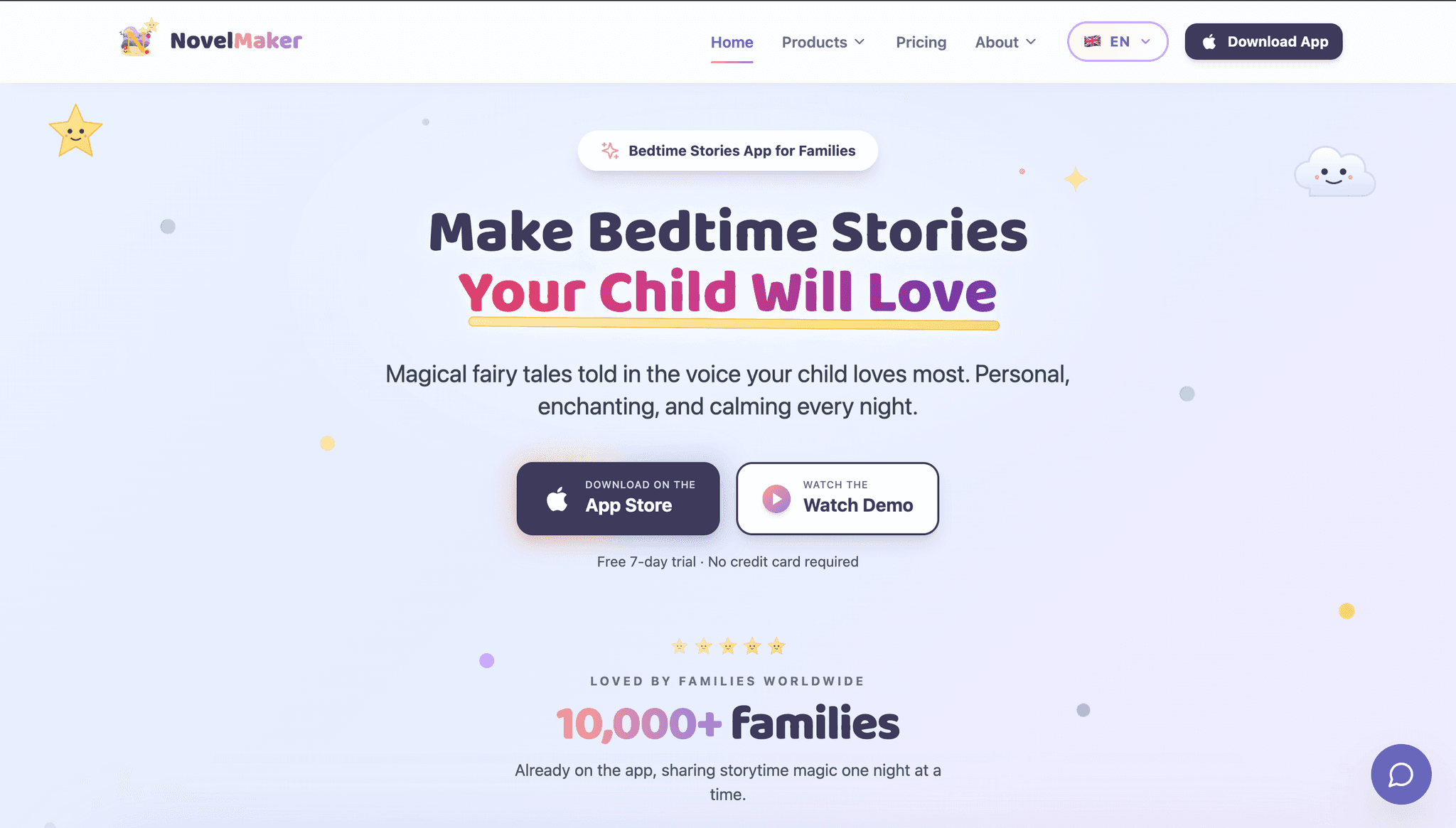
NovelMaker is an iOS app that turns bedtime into something personal: magical fairy tales narrated in a voice a child loves: a parent's or grandparent's own. It's a genuinely new idea, and that was the marketing problem hiding inside a good product. Most parents don't have a name for it yet.
So they don't search a keyword. They describe the thing to an assistant: "an app that reads my kid a bedtime story in my voice." That's a query no traditional keyword strategy captures, and NovelMaker wasn't the app that came back. For a category-defining product, being absent from that first described-not-searched moment is the whole battle.
We treated it as a category-creation problem, not a ranking one: define the category in language parents actually use, structure the product's facts so a model can lift and quote them, and build the comparison and corroboration content that gets a young brand named in an answer instead of skipped.
At a glance
The client
NovelMaker, a consumer iOS app that generates personalized, voice-narrated bedtime stories for children, letting families record fairy tales in a parent's or loved one's own voice.
The challenge
A net-new product category with no established search term. Parents describe what they want to AI assistants rather than searching for it, and NovelMaker had no presence in those described-not-searched answers.
What we did
Defined the category in parents' own language, gave the product a clean entity, structured its key facts to be quotable, and built comparison content engineered to be lifted by answer engines like ChatGPT and Perplexity.
The results
A product that engines can now recognize and describe, positioned to be named when a parent asks an assistant for an app that reads bedtime stories in their own voice, a query that returned nothing relevant before.
Want results like this for your brand?
Talk to a Growth StrategistYou can't rank for a word nobody searches yet
Traditional SEO assumes the demand already has a name. You find the keyword people type, and you compete for it. But NovelMaker sits in a category so new that most parents have no term for it. Nobody searches "personalized voice-narrated bedtime story app". They don't know that's a thing.
What they do instead is describe the outcome they want, more and more often to an AI assistant: "an app that reads my kid a story in my voice," "something that makes bedtime stories with my child's name in them." That's a fundamentally different discovery pattern. It rewards products whose facts and benefits are structured clearly enough for a model to match the description, and it punishes products that only optimized for keywords that don't exist.
Naming and structuring the category
Our first job was linguistic: define the category in the exact words parents use, not the words a product team uses internally. "Personalized bedtime story," "stories in a parent's voice," "bedtime app for kids": the plain-language phrases that a model will try to match against.
From there we gave NovelMaker a clean, machine-readable entity and structured its core facts into the crisp, quotable form answer engines prefer to lift: what it does, how the voice personalization works, what platform it's on, how the trial works. Finally, we built comparison and corroboration content, because a young brand rarely gets named on its own say-so; models look for the product to be described and referenced across sources they trust before they'll recommend it.
Optimizing for the answer, not the ten blue links
For a category creator, the prize isn't position #4 on a results page. It's being the specific product an assistant names when a parent describes the problem NovelMaker solves. That's Generative Engine Optimization: engineering the entity, the structured facts, and the corroboration that make a model reach for you.
The outcome is a product engines can now recognize and describe accurately, positioned to be the answer to a described-not-searched question that, before this work, returned nothing relevant at all.
Facts below are drawn from NovelMaker's own website and App Store presence, and used to structure the product's entity. The families figure is self-reported by NovelMaker; search- and AI-visibility metrics are not shown because analytics access has not been connected.
- Families using the app
- 10,000+Families using the appSelf-reported by NovelMaker
- Available on
- iOSAvailable onApple App Store
- Free trial
- 7-dayFree trialNo credit card required
| Detail | Value |
|---|---|
| Platform | iOS (Apple App Store) |
| Category | Personalized bedtime-story app |
| Personalization | Fairy tales narrated in a parent's or loved one's voice |
| Trial | Free 7-day, no credit card |
Product facts sourced from NovelMaker's website; the families count is the company's own figure, shown as attributed rather than as a measured result. Connect analytics to populate verified visibility metrics. None are estimated.
- A named category for a product that had noneLive site
- Parents describe the outcome they want rather than searching a product term. The category was written out in that same language, so there is something for a model to match a description against.
- Core product facts structured to be quotableLive site
- What it does, how the voice personalization works, which platform it runs on and how the trial works, each stated as a discrete, liftable fact rather than buried in marketing prose.
- Corroboration built outside the brand's own claimsLive site
- Comparison and reference content, because a young product rarely gets named on its own say-so — models look for it to be described across sources before they will put it in an answer.
Every line above is retrieval and structure — the conditions that make a brand eligible to be named. None of it claims this client is currently cited in any given answer: that requires a prompt panel run on a schedule, which is measured per engagement rather than asserted here.
NovelMaker: common questions
What is NovelMaker?
NovelMaker is an iOS app that creates personalized bedtime stories for children, narrating magical fairy tales in a parent's or loved one's own voice. It's designed to make storytime personal, calming and repeatable night after night.
What is a personalized bedtime-story app?
It's an app that generates custom children's stories tailored to a child (often by name) and, in NovelMaker's case, narrates them in a familiar voice such as a parent's or grandparent's, rather than a generic recording.
Why is a new product category hard to find in search?
When a product is genuinely new, there's no established keyword for it. People describe what they want in their own words, increasingly to an AI assistant, so discoverability depends on defining the category clearly and structuring the product's facts so a model can match that description and recommend it.
How do you optimize a new category for AI search?
By naming the category in the language buyers actually use, giving the product a clean, machine-readable entity, structuring its key facts to be quotable, and building comparison and corroboration content, so answer engines can confidently name the product when someone describes the problem it solves.
Further reading from the journal
+2
Want to be the brand the models name?